Search This Blog

Friday, February 27, 2015

Going "Straight": Why it doesn't matter that reparative therapy doesn't work.

A recent study by a retired BYU professor and his colleague at Utah State found that gay Mormons in a heterosexual marriage have a high likelihood of divorce. Shocker, I know. However, the article included several other interesting statistics, such as that 70% of the individuals had left the church either before or after their divorce, and that 80% of them had made some kind of efforts - private, groups, religious, therapy, etc - to change their orientations, all unsuccessfully.

This is a common finding regarding the effects of "conversion" or "reparative" therapies - very few have demonstrated any kind of success, and some even employ strategies that have been damaging. The Pan American Health Organization, a regional office of the World Health Organization, has stated that these practices “lack medical justification and represent a serious threat to the health and well-being of affected people.” In 2000, the American Psychiatric Association published that, “‘reparative’ therapists have not produced any rigorous scientific research to substantiate their claims of cure” which has led them to “oppose any psychiatric treatment such as reparative or conversion therapy which is based upon the assumption that homosexuality per se is a mental disorder."

This brings up some interesting questions. Why isn't homosexuality a disorder anymore? Why did it used to be? What makes something a disorder like ADD, or transgenderism, or bibliomania (compulsive book-collecting - I think my husband and I have this)? And thus we leave the realm of science and enter the sociological swamp of competing ideologies. Here's the issue: What we can ethically "treat" depends on what we consider to be a "problem".


In general, when someone presents any kind of unique condition, we generally place it into one of two categories: for this article I will conceptualize them as "disorder" and "orientation". A disorder is a problem that we agree needs to be fixed. An orientation is just a characteristic that makes someone different. 

Many conditions have switched categories in the past - being left handed, for example, which used to be considered a disorder, is now a relatively neutral condition (which I am personally thankful for). Hyperactivity in children has gone from being considered an orientation to a possible disorder. We may pretend that there is a scientific difference between these categories: The APA has created a rubric for determining whether something is considered a disorder - such as requiring it to be "distressing" or to negatively impact one's life, etc. - but even those definitions are derived from our values, and full of moral assumptions. Giving something a definition does not mean it has anything to do with science - like whether you label an embryo a "human being" or just a "clump of cells". It's a moral label, not a scientific one, but that label has real implications.

For example - if you see homosexuality as simply an orientation because you believe that there's nothing WRONG with it, then you obviously don't want it to be considered an illness. The illness label creates negative stigma and unneeded pressure to change (imagine me and a bunch of lefties with inferiority complexes).  People who believe that homosexuality is morally acceptable therefore obviously disapprove of orientation change efforts, even if the change efforts were effective

On the other hand, if you believe that patterns of homosexual thoughts, feelings, and emotions ARE a problem, then it does make sense to continue pursuing change strategies - even if CURRENT modalities are ineffective.  If we agree it's a problem, then we'll continue researching and experimenting and looking for better solutions - like we do with every other mental and emotional condition of concern. 


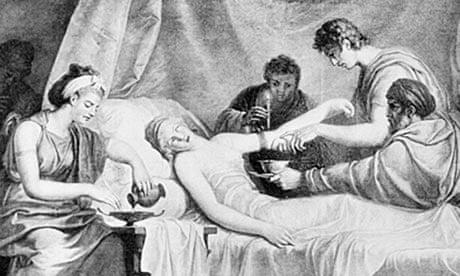
Here's the problem: If people with moral oppositions to changing someone's sexual orientation rush to publish the negative results of  existing modalities in order to make their viewpoint look like a rational and not a moral one, they miss the point. Existing modalities are irrelevant to the argument. If orientation change therapy is morally wrong, then it shouldn't matter if it's effective of not - it's wrong, and it should stop. And if changing one's orientation is morally right and important, then it shouldn't matter if our current tactics are effective or not - it's right, and we'll keep working until we figure it out. Remember how many things were tried before penicillin?


Blootletting scene from the 1600's

Bad current treatments are not evidence of an incurable condition.

What's even sadder is that those who are actively fighting against and shutting down attempts to change people's orientation prevent those who WANT to change from having the chance to do so. The APA discourages it; no respected grants promote research in that field. In fact, conversion therapies of any kind are banned for minors in California, New Jersey. and Washington D.C., effectively shutting down the conversation entirely and preventing new and better therapies from ever being developed. For a group that seems so intent on preserving individual rights and freedoms, that seems to be an awful lot of hand-tying.


In some ways, sexual orientation is unlike being left or right-handed. It's fluid; some people feel it to varying degrees and in different ways. Some people have been gay from birth, while others develop a gay orientation because of circumstances such as childhood abuse. Queer theorists agree with me. So if we already acknowledge that orientation has at least an element of changeability, and since clinicians commit to not impose our morality on client, then at the very least, don't people deserve the right to pursue an orientation of their choosing, with our support? For a child whose sexual feelings have been skewed through abuse and desperately wants to change; for a father who has a wife and kids that he loves - shouldn't we at least allow strategies that might help these people, and preserve their families? Or are we so presumptive as to assume that ANY efforts in ANY realm of change strategies are doomed to fail? 

As a Mormon and an American, I respect the right for others to disagree with me on moral and religious issues. I can respect people who reject the concept of changing someone's sexual orientation. But let's not hide behind the weak argument that the whole idea should be rejected outright just because there happen to be bad therapies out there. It is a moral issue, and both sides are taking a moral stance.  If you are someone who believes that homosexuality is a disorder that should cured, then let's stop defending bad programs and let's get to work figuring out how to do it right. A lot of people are waiting on us.






Monday, January 12, 2015

You Can't Have Your Cake and Eat it Too: Why We Will Never Agree on Race

While writing this post, the following clip from Fiddler on the Roof came to mind:


One man argues that worrying about the world outside is useless. Another argues that we can't close our eyes to the outside world. "He's right, and he's right... they can't both be right." ... "You are also right"!!


Tevye humorously illustrates an important issue about which religious folks and social scientists often disagree. That is, while we allow for the differences in perspective and cultures, Christians recognize that there are sometimes two things which cannot simultaneously be right.  Social scientists are adamant about their own fundamental uncertainty about truth, and point to the vast relativity in perception and morality that exists between cultures. However, unless you are Nietzsche, you must acknowledge that some fundamental realities exist outside of our conception of them. There is either an afterlife or there isn't. Jesus either rose from the dead or He didn't. Yesterday was the same 24 hours long as the day before. I am currently in my apartment, and not in Spain.


Sometimes, however, we want two contradictory realities to both be right - thus the expression, "you can't have your cake and eat it too". You can either eat the cake, or leave it on the plate and continue to hungrily lust after its buttercream frosting. You can compromise - eat half of it, and keep half of it - but the whole cake cannot be on your plate and in your stomach simultaneously. You must choose.


This year, a ballot is being put forth in the Colorado legislature regarding the concept of "feticide" - the killing of an unborn child - and whether it should be considered illegal. Years ago I read an interesting example of this dilemma: a very pregnant woman was robbed on the street and stabbed in the stomach. She survived but her unborn child did not. When the man was apprehended and taken to court, she was dismayed to discover that there were no laws in her state against "fetal homicide" (12 states do not). In an interview, she affirmed that she considered herself pro-choice, but was still frustrated by the lack of legal protection for her baby. Unfortunately, she was confronted by the dilemma of both wanting a fetus to be a person, and also not a person, depending on whether the mother wanted it or not. Like the cake, we cannot have it both ways.


Here is another dilemma: Does race matter, or not? Here are some scenarios to check your racism meter. Which of the following would you consider to be examples of racism?


  1. In the movie Star Wars: Phantom Menace, one alien race all have Jamaican accents
  2. A TV show has very few non-white actors in its cast, and those who have "have had their identity minimized."
  3. When asked which of the women in the shop was Melissa, she said, "The black one."
  4. White American women don't tend to be attracted to Asian guys.
  5. Once a year, we have "Black History Month" but there is no equal representation for Hispanic or Asian Americans.
  6. A white guy hosts a Mexican-themed party where the guests arrive in sombreros and ponchos and watch The Three Amigos
  7. A black girl straightens her naturally curly hair to style it like her caucasian friends.

Here's a surprise: the answer to all of these is absolutely yes, or no, depending on your answer to the following question... 
What is racism? 
Your definition of racism actually depends a great deal on your definition of race, and whether or not you think it matters as a meaningful and fundamental part of one's identity. Here are three of the most common definitions of racism:
1. Racism means acknowledging race, and pointing out racial differences --> racial stereotyping.
2. Racism means NOT considering race, treating everyone like white people, pretending "blackness" doesn't exist and hoping any differences you do notice go away.
3. Racism is just another word for racial discrimination - viewing and treating people of other races as inherently inferior. 
While I think everyone can get behind #3, there is a vast difference between racism definitions 1 and 2. What do we do with these three definitions which are so different?

Fundamentally, our national dilemma is whether race matters or not. Does race make you the same, or does it make you special and unique? We can't seem to agree. All of our difficulties in discussing race seem to flow from this basic conundrum: are we the same, or are we special? Are differences real or not? Are they important or trivial? Should we ignore race or celebrate it? Here is an example of each approach. 

Celebrate it: This year President Obama and his family sent their prayers and best wishes to those celebrating Kwanzaa, stating that "Kwanzaa celebration highlights the rich heritage of African Americans."
Ignore it: In an interview with Mike Wallace in 2005, Morgan Freeman called Black History Month "ridiculous" - saying that relegating one month to one race's history puts up unnecessary boundaries between blacks and whites. "Black history is American history", he said:


So, which is better? Which approach do you believe will do a better job of eliminating racial inequality and tensions? 


Those who argue for color-blindness believe in equality and not considering your race when making assessments about you; they see that every attempt to categorize people by race and discuss their differences accentuates the problems and the sense of "other"-ness that lead to stereotyping and discrimination (this concept when applied to gender is widely accepted by most social scientists).


Those who argue for multiculturalism believe the solution to racial problems is by acknowledging, not ignoring, race; they believe that celebrating and seeing the value in one's racial background builds self-esteem and strength in individuals and communities.


To be honest, I don't know the answer, but what is clear is this: these perspectives are mutually exclusive. Race, like gender, cannot both be both trivial and special. Over and over again, our attempts to ameliorate race relations problems in this country either causes us to acknowledge, measure, and discuss race, which annoys the color-blinders, or to ignore race and focus on unity, which offends the multiculturalists.


This is not fun for any of us though, because it means regardless of which viewpoint we adopt, we must recognize and accept all of the consequences of our chosen package, good AND bad:


If we ignore race in our efforts to promote equality, we lose the cultural identity that gives many people a sense of pride and community. We leave the door open for people who do still harbor racist ideas to segregate and discriminate, whether they do it knowingly or not. By making race irrelevant, we no longer have a way to quantify and address problems that are clearly driven by racial attitudes, and we leave whole swaths of the population at a historically perpetuating disadvantage. We say we believe in the equality of all men, but as President Obama has said: "Those self-evident truths have never been self-executing."

On the other hand, if we continue to use race as a salient characteristic of certain groups of people, the younger generation continues to grow up learning that some people are different than we are, and that they need to be treated differently (given extra help, etc.). If it matters, and it IS a relevant part of one's identity, then one's race matters and can therefore be used to make judgments about them - both good AND bad. For example--That's called stereotyping. Are we okay with that? 

Whether we ultimately choose to eat the cake or gaze longingly at it, we must recognize that there will be negative consequences either way, and a lot of people are going to be unhappy about it.

What is the official stance of the government? The Supreme Court's position is that in a federal case, the race of the plaintiff or defendant is not to be considered, UNLESS race is being considered in an effort to justify past racial discrimination, or to promote diversity in higher education (Fisher v. University of Texas and Regents of the University of California v. Bakke. In other words - race is a meaningful component of one's identity.... or not... depending on whether it's considered a worthy cause.


What is the stance of the NAACP? The organization seems to straddle both sides as well, claiming to both use "affirmative action" with regards to race and other statuses, AND to be an "equal opportunity employer". But legally, this doesn't work. The concept of "equal opportunity employment" as stated in Title VII of the Civil Rights Act of 1964 and Executive Order 11246 by Lyndon Johnson refers to a prohibition on discriminating against employees on the basis of race, sex, creed, religion, color, or national origin. And discrimination means recognizing differences between people, and then treating people differently as a result of those differences. Isn't that what affirmative action is doing?

Here's the thing though - affirmative action might be the right thing to do. Discriminating in one direction may be the best way to address historical discrimination in the other direction. But it is still discrimination. It is still differentiation of people based on their race. And that approach has both positive and negative outcomes. We just have to recognize that that is in fact the case, and then make the decision about whether or not it's worth it.

Unfortunately, like the Supreme Court's confusing position on race, it is irrational to decide whether something like race is real and meaningful and important only when we want it to be. The shoe that you drop on the floor will still be there when you're stumbling around in the dark, whether you want it to be or not. The alarm clock you set will go off, regardless of how little sleep you've gotten.

So how do we choose? Like all of our actions in society, our decision about how to treat race should not focus on theory (what sounds good), but on outcomes (what actually works) - (see this lesson from Moneyball). Recognizing the deeply sensitive nature of this issue, we should be wise, acknowledge the fact that either decision has pros and cons, and then have the courage to choose the approach that will ultimately lead to the most equality, the least discrimination, the most inclusiveness and happiness.


In the spirit of outcomes, and in an effort to avoid researcher bias, I think one helpful approach would be to study the current and historical approaches of other societies that seem to be ahead of the curve on racial equality, such as (in my opinion) the United Kingdom (<-- this post is fascinating. Experiences of black individuals who have lived in both the U.S. and the U.K.. I will talk about this more in my next blog post about my own experience with racism).

Until we recognize that there is in fact two mutually exclusive opinions on race and racism, we will continue to fearfully avoid discussions of race and condemn any mention of race with blind indignity, for fear of being considered either racist version #1 or #2. 


As far as theoretical paradigms go, I am not a conflict theorist - I believe most people genuinely want racial equality. I believe we are all trying to accomplish the same objective, but that we have different (and admittedly contradictory) approaches to solving it. We need to stop condemning people as "racist" because their strategy differs from ours, and not "make a man an offender for a word" (Isaiah 29:21). Whatever WE decide to do with the cake, let us be loving and patient with others who are still struggling with the decision. However we choose to view race, the logical result will have positive and negative outcomes for everyone. Let's be both sensible and sensitive as we work together to find solutions.

Sunday, September 7, 2014

Married, Alone: The Implications of Commuter Marriages


"A long distance marriage is two people trying to dance a duet and two solos at the same time." Anne Taylor Fleming

A few years ago, two of our friends met in the same PhD program and decided to get married. Upon graduating, they were faced with a dilemma. As they both specialized in the same, extremely competitive field, they found themselves both applying for the same handful of jobs in the area, with no success. After a while, they decided to change their tactic. They would each apply for jobs all over the country, and take whatever they each could find. If they ended up in different states, they would just have to travel back and forth. "It stinks," they said "but... you've gotta do what you've gotta do."
This solution is becoming increasingly popular for couples pursuing independent careers. Last weekend, I mentioned to a friend that my husband had just accepted a year-long clerkship with a federal judge in another state. Her response: "A year huh? That's a pretty long time to have to be apart... I mean, are you planning to quit your job?" I was surprised. Of course I would quit my job. It would never even occur to me that any job would be good enough that it would be worth sacrificing a year of married life with James. It had literally never entered my mind.
But while living long-distance has never entered my mind, it has clearly entered the minds of many other couples. According to the U.S. Census Bureau, over 3.5 million couples in the United States live separately for reasons other than an impending divorce. Many of these are "commuter marriages." This number has more than doubled since 1990. 1

Why the increase?

Well, some couples are obviously separated by uncontrollable issues, such as deployment or immigration issues, and there are others who may simply enjoy the time apart 2 3, but I imagine the majority of couples in long-distance marriages are probably struggling like our friends in graduate school. These are couples who are happy in their relationships, who enjoy each other's company and genuinely want to be close to each other, and yet they make the decision to live apart at least a majority of the time, sometimes for years - sometimes to avoid disrupting children's education, but usually to accommodate one spouse's job. 4

Some might argue that people care more about their jobs than their families, but the research doesn't actually seem to bear that out. In fact, parents (and especially dads) are spending more quality time with their families than ever before. According to a survey by Dove, 94% of dads claim to prioritize their family above their job, and married couples in America are overwhelmingly satisfied with their level of equality and overall relationship satisfaction. 5

I believe that the deeper reason for the increase is the changing definition of what it means to be a husband or a wife. When women like myself struggle with being separated from our spouses, a big part of us feels guilty, as though we should be able to handle separation without problem. Probably stemming from both a strong diet in feminist theory and good old-fashioned American individualism, we increasingly believe two strong and independent spouses are a signal of a good marriage, and spending time apart in order to fulfill our individual needs is, strangely enough, one way of proving how strong our marriage is.

There is more evidence for this assumption. While most American claim to want marriage and true love, we increasingly make decisions that pull us away from it. We date less, marry later, cohabit instead of marry, have children outside of marriage, and generally make ourselves less available for relationships. These practices seem to signal our desire for independence, but they also conflict with our desire for a happy, interdependent marriage. And while many couples make it work, most agree that either one spouse's career or the relationship usually end up suffering - sometimes even leading to divorce 6.

As I mention in an earlier post, the concept of vulnerability, and relying on one's spouse, and even being "incomplete" without them, is actually a paradoxical STRENGTH disguised as a weakness. Interdependence, not independence, is the critical component that ties a husband and wife together.

Romance "vs." Responsibility?
Am I a little pathetic for not pursuing my current career because...I'm lonely? Is my romantic side a childlike fantasy that needs to be governed by the responsible part of me? Well first of all, contrary to popular belief, men are far more romantic than women. They are more likely to believe in love at first sight, more likely to believe in soulmates, destiny, and things like that. Historically, women are far more pragmatic when it comes to love. In fact, an older survey showed that women ranked "love" as only #5 on their list of reasons to marry someone 7. Women are also more likely to initiate legal separation 8.

However we feel about romance, women are also seem to be more conflicted about their careers. Women are slightly more likely to sacrifice romance for achievement, but women also tend to get MORE stressed out by their jobs than do men. Women in part-time jobs or who stay at home tend to be happier than those with full-time careers 9, but while women are still more likely to prioritize family commitments over work commitments, it's interesting to note that there are still far more likely to place practical concerns above romance than are men 10.

How do we explain these apparent contradictions? I think one key is recognizing how society increasingly separates the concepts of romance, marriage and family. Women's priorities are not so much dictated by the area of our life as by the degree to which each area feels like a responsibility or a pleasure.

Romance strengthens marriages, and marriages strengthen children. When we fail to associate these concepts,  we feel guilty about romance, we struggle to prove our independence in marriage, and we both create a less stable foundation for the rearing of children and communicate these unhappy messages to them. How lame is that?

Sex is the perfect example of this disconnect. Outside of marriage and commitment, sex is generally a selfish activity. But sex in marriage is important for one's relationship - a way of healing hurt, unifying, refocusing, deepening your love and commitment. So should married couples be proud of themselves for being apart, and therefore not having much sex? Only if you still think like a single person. When married, your investment in the passion and romance of your marriage is the responsible choice.
Fear of Indulgence
When not associated with other familial responsibilities, romance and togetherness is often viewed as an indulgence, not a priority. Spending time with the person you love is a delightful thing, like a donut, that inspires guilt if consumed in large quantities. Indulging in a relationship - dating, intimacy, quality time and physical closeness - taps the part of our brain that worries about how many calories we've consumed.


As empowered women with a need for self control, we dutifully put romance aside with increased frequency, or only give it limited quantities of time. We're proud of ourselves for this. It's refreshing and empowering. Even when I miss my husband, I can't deny that I feel pride at my identity as a strong, independent woman, and I need to let myself and everyone else know that I can go for an impressively long time without "caving in" like I'm referring to a donut.
When we view romance and togetherness in marriage as a selfish personal desire, we feel guilty about making it a top priority.

Unconditional + Quality:
Just like sex, there is a fundamental difference between romance in dating and romance in marriage - and the latter is far more important. John Van Epp, author of How to Avoid Falling In Love With A Jerk, explains that the divide between dating and marriage is not a simple legal status - it is a fundamentally different type of relationship. A dating relationship, for example, depends on the quality of the relationship, and the enjoyment that both parties derive from it. When one or both people aren't enjoying it, the relationship usually ends. Marriage on the other hand is an unconditional commitment, meaning that each person vows to love and cherish "for richer or poorer" etc., meaning regardless of the quality of the relationship and no matter how unpleasant it may get:

The conditions of dating: quality 
The conditions of marriage: none

So why would anyone go and get stuck in an unconditional relationship like marriage? Well, without writing another whole blog post about it, there are some clear benefits - security, comfort, the ability make long-term plans together, the ability to be completely vulnerable. It's like knowing your mom will always love you no matter what. Unconditional is nice.

But, to the point: It's not enough for marriage to be unconditional. Almost no one will stay indefinitely in a terrible marriage, no matter how committed they feel. Therefore, quality becomes a necessary aid in helping us fulfill our promise to be committed unconditionally. Each spouse has a responsibility to make the unconditional relationship a quality one as well. When we recognize that romance and togetherness is critical for not just our well-being but the well-being of our spouse, it becomes an act of love as well as pleasure. Kind of like sex.

Marriage: Good for You, Good for Everyone
We don't need to be condescending or suspicious of a desire to be married, and we need to stop feeling superior to others who won't tolerate long separations by implying that they "can't handle" it (as stated in this Huff Post interview). We would be just as foolish to scoff at someone who "can't handle" secondhand smoke. Statistically speaking, the smoke inhalers are better off! On average, married people tend to be physically and mentally healthier. They tend to acquire more wealth. They live longer. They experience less violence and crime. They're more active in their communities. Their kids have better outcomes in virtually every measurable way. They're happier. These are not the products of indulgence - these are the fruits and vegetables of a good life. We're just suspicious because vegetables don't usually taste this good.

Finally, we need to make the mental connection between our romance, our marriages, and our families (i.e. kids). Kids benefit more from having parents wildly in love with each other than they benefit from having good teachers, good friends, or even good doctors. If you feel guilty splurging on a weekend getaway, or even giving up a great career opportunity in order to be close to your spouse, you can say, "I'm doing this for the kids."


We should thank our lucky stars that in this case, romance is both the desire of our hearts and the essential component of a relationship that is critical to the well-being of individuals, children, communities and society. When you "indulge" in the togetherness and romance that makes life sweet, you are also doing the best possible thing for your spouse, your future kids, your community and your whole society. You are demonstrating the value of interdependence above independence. That should be worth giving up a great job for.

It Isn't Good To Be Alone 
In Genesis we read that on the sixth day, God made Adam, and then made Eve so Adam didn't have to be alone. God could have taught Adam the importance of self-reliance. He could have helped Adam realize how much he could accomplish by himself and how to be independent. I'm sure he could have brought in Eve just when reproduction needed to happen. But I think a more important lesson needed to be learned, about love, unity, and the power of two people working together. The commandment to "cleave" unto our spouse is both a commandment and a blessing, and I think it is ultimately a testimony of God's love for us. We must develop the togetherness that fuels romance and a strong marriage, for our own sake and for everyone else. Our task and our reward is the same: We are meant to love. It only seems too good to be true.

Saturday, July 5, 2014

Being Brave: Where Sara Bareilles Gets It Wrong

You may have heard this song:

I like Sara Bareilles. A lot, actually - I keep singing her songs and wishing my voice sounded like hers. But this song bothered me when I heard it for the first time, and I've thought about it a lot over the last several months.

In the music video, Sara encourages the audience to "say what you want to say, and let the words fall out....honestly, I want to see you be brave," while a racially diverse cast of actors demonstrate their bravery by dancing alone in various public places.

Don't get me wrong - I am a fan of dancing like no one's watching. Last night in fact, I danced with a four year-old to "Party In The USA" surrounded by thousands of people watching the fireworks. And maybe that's one definition of bravery. But that's not the one that really matters.

I used to think that bravery meant just breaking social norms. A norm (folkway, more pronounced mor-ay, or taboo) is a social convention or rule derived from a set of of social values. Norms range in importance from not slurping your soup to not eating people. As members of society, we generally understand what behavior is socially appropriate, and we win the approval of others by conforming to that standard.  

One of the fun experiences of nearly all sociology students (myself included) is discovering what social norms are, and realizing how fragile they are. In fact, a common assignment for Intro to Sociology students is to break a norm and then write a paper about it. You can sing in public. You can sit down on the elevator. You can take things out of other people's shopping carts. You can say something other than "fine" when someone asks "How are you?"

But bravery doesn't just mean breaking norms, because not all norms are equal: Some social norms are inherently good (like loving your spouse), some are inherently bad (like making fun of disabled people), and some don't matter (like holding the fork in your left hand). I would venture to say that most of the daring, norm-breaking behavior of "enlightened" students tends to fall in the third category.

I would also venture to say that there are some forms of so-called norm breaking that aren't actually brave at all, since some norm-breaking actually IS a norm in our popular culture! Rebelliousness can still be cool, and still qualify you for an approved social category (like hipsters, or hippies, or metros). 

True bravery means doing what is right when current social norms are wrong. It isn't enough to just break whatever norms we don't like. We need to break them for a good purpose. Dancing in public may be "challenging the system" and "breaking free" but so is never bathing. We need to learn which norms are ultimately detrimental or unnecessary, and then break them when needed.

This is where Sarah Bareilles comes in:

You can be amazing
You can turn a phrase into a weapon or a drug
You can be the outcast
Or be the backlash of somebody’s lack of love
Or you can start speaking up


The message here is beautiful and important: words have power, and you can use them for good or for evil. The problem is how she ties it up:

Say what you wanna say
And let the words fall out
Honestly I wanna see you be brave
With what you want to say
And let the words fall out
Honestly I wanna see you be brave


Sara's interpretation of "speaking up" and "being brave" means "say(ing) what you wanna say," and I think she misses the mark. Being brave does not mean just saying what you want to say - lots of people do that. You can be a jerk and claim that you're just being honest, or state your opinion in a way that hurts someone's feelings, or say something because you want attention: that isn't enough. Being brave means saying the thing you desperately do NOT want to say. It means doing what is right, not what you want

Everybody’s been there,
Everybody’s been stared down by the enemy
Fallen for the fear
And done some disappearing,
Bow down to the mighty
Don’t run, just stop holding your tongue

"The mighty" that we need to stop bowing down to isn't "The Man" (or the government, or big business, or whatever), it's your friends. As a wise wizard once said:


Let's not kid ourselves - In a country with free press and free speech, standing up to the government is not a particularly brave act. It's much harder to stand up to people in your life who you respect and love, and sometimes even stand up for causes that other people think are blatantly wrong. 

Despite what superhero movies portray, true courage means doing the thing that does NOT come with ANY glory or admiration, sometimes even from your own family members; they may make others think less of you, misunderstand you, and look down at you. Bravery may be doing the thing that you know will lead to other people calling you a pervert, a fanatic, or a bigot. 

Some of the values you stand up for may be popular, like civil rights, or unpopular, like chastity and modesty. Real courage is standing up for things that are good AND unpopular. Those courageous actions are far less entertaining than a music video, and usually less comfortable and heart-warming than a Hallmark movie. You may have to stop the music. You may have to ruin the party. You may lose friends. 

In General Conference, President Thomas S. Monson said:
"It is impossible to stand upright when one plants his roots in the shifting sands of popular opinion and approval. Needed is the courage of a Daniel, an Abinadi, a Moroni, or a Joseph Smith in order for us to hold strong and fast to that which we know is right. They had the courage to do no that which was easy but that which was right.
We will all face fear, experience ridicule, and meet opposition. Let us - all of us - have the courage to defy the consensus, the courage to stand for principle. Courage, not compromise, brings the smile of God's approval." 
One of the difficulties in being brave is that it requires you to take actions for people and causes that you're not even necessarily passionate about. The Becket Fund, mostly Christian lawyers, defends Christians against religious discrimination... as well as Muslims, Jews, and other groups with whom they disagree. It's easy to speak up against human trafficking and racism and child abuse. It's harder to advocate for the free speech of terrible people, or be a friend to a bigot, or testify of improbably religious beliefs, or publicly advocate for sexual abstinence and other awkward topics. 

Can you imagine what you would do if you had been Joseph Smith and God came to you and said, it's time to bring back polygamy? Or if you were Spencer W. Kimball and God continued to command (even ten years after the Civil Rights Movement) that the Priesthood not be given to people of African descent? Regardless of your beliefs, you have to admit that that would be insanely hard! Following the commandments and having integrity to the things that we know are true doesn't mean we're going to be excited about it at all. 

Superficial bravery like dancing in public is still a wonderful part of life. But let's not pat ourselves on the back for it - true bravery is still needed for doing the thing that you least want to do, the thing that needs to be done, whenever it is needed, regardless of whether anyone will see, or whether EVERYONE will see and think less of you for it.

Lots of us are committed to acting crazy and out-of-the-box for the sake of personal fulfillment and memorable Facebook photos. Let us commit to being truly brave - unpopular and uncomfortable - in standing up for the things that are right.


Thursday, June 19, 2014

"Ladies and Gentlemen" (or, The Purpose of Princesses)


Every four-year old American girl worships princesses...Disney ones especially. My niece and my friend's daughters have princess clothing, bikes, dishes, dolls, makeup cases, bedsheets, coloring books...even a princess fishing pole. I have rolled my eyes at this obsession, partly due to my aversion to hot pink, and possibly because when I was four, I had an older brother, so naturally my toys of preference were his Ninja Turtle action figures.
Just in case you didn't believe me.

My husband has a pet peeve against royalty as well, but the real kind. He refused to watch the wedding of Prince William and Kate and mocked others for doing so. "That's the reason we CAME to America! Because we didn't want royalty!" He argues, rightly so, that the idea of one individual or family receiving government-sponsored wealth, honor, and privileges at the expense of everyone else is fundamentally un-democratic, and we should stop envying and adoring the products of that system.

Some people go beyond royalty and even have issues with the terms "lady" and "gentleman". One recent blog post recommended never addressing a group of women as "ladies". It's better to say "people" or "folks", they say, to avoid making women feel labeled by their gender.

I have recently discovered that princesses actually have an important purpose, along with royalty in general and the terms "lady" and "gentleman". Let me share a book that illustrates why:

In the story of The Princess and the Goblin, George MacDonald spins a delightful tale about a little 8 year-old princess and a miner boy who fight against goblins threatening to kidnap her and take over the kingdom. Along the way, the author occasionally points out (in a quaint, turn-of-the-century way) some of the things we should know about princesses:

"Lootie! Lootie! I promised a kiss," cried Irene 
"A princess mustn't give kisses. It's not at all proper," said Lootie. 
"But I promised," said the princess. 
"There's no occasion; he's only a miner-boy." 
"He's a good boy, and a brave boy, and he has been very kind to us. Lootie! Lootie! I promised." 
"Then you shouldn't have promised." 
"Lootie, I promised him a kiss." 
"Your Royal Highness," said Lootie, suddenly grown very respectful, "must come in directly." 
"Nurse, a princess must not break her word," said Irene, drawing herself up and standing stock-still.... 
She never forgot Curdie, but him she remembered for his own sake, and indeed would have remembered him if only because a princess never forgets her debts until they are paid...
Subtle comments like this throughout the book explain that princesses are polite, brave, and respectful. Princesses keep their promises. Princesses reward those who have shown kindness. Princesses aren't haughty about their credentials. Princesses never look down at others who have worse behavior than they. As one critic said of MacDonald's book and its sequel, they “quietly suggest in every incident ideas of courage and honor." Do these sound like frivolous or sexist or outdated characteristics? No way! We still teach these to little girls today!

The clue to the author's intentions are at the very beginning of the book:
"But Mr. Author, why do you always write about princesses?" 
"Because every little girl is a princess." 
"You will make them vain if you tell them that." 
"Not if they understand what I mean." 
"Then what do you mean?" 
"What do you mean by a princess?" 
"The daughter of a king." 
"Very well, then every little girl is a princess, and there would be no need to say anything about it, except that she is always in danger of forgetting her rank, and behaving as if she had grown out of the mud. I have seen little princesses behave like children of thieves and lying beggars, and that is why they need to be told they are princesses. And that is why when I tell a story of this kind, I like to tell it about a princess. Then I can say better what I mean, because I can then give her every beautiful thing I want her to have."
Notice that the archetypal princess is not about superiority to other people. In reality, there are no commoners. Peasants and commoners are background characters representing the ordinary, every-day version of mankind, something that we each have a royal duty - nay, a destiny - to rise above. So, why should we be okay with princesses? Because princesses remind us of our best selves. Royalty serve as the example for how a "lady" and a "gentleman" behave. 

In the book, the nobility of Princess Irene is juxtaposed against the crudeness of the goblins. They live underground, they kidnap and rob people, they're rude and they don't wear shoes and they make fun of the humans whose kingdom they plan to overthrow. The goblins in this story aren't just ugly and unusual - they are also uncivilized. Being "civilized" is what allows us to create and sustain "civilization"; it is what distinguishes us from animals and Lord of the Flies. It incorporates more human attributes like honesty, tolerance, and justice, as well as even more refined qualities such as grace, modesty, kindness, cleanliness, restraint, and sophistication. When we call a woman or girl a "lady" we are not categorizing her; we are complimenting her. She shows mastery of her appetites and passions. She possesses high morals and noble intentions. She is the kind of person we want our daughters to look up to.


What's more, the author makes it clear that the term "princess" (and "lady") does not refer only to a select group of outwardly refined individuals. "Every girl is a princess" he wrote, because every girl, as a daughter of God, is a "royal" creation from birth, and therefore has the innate (I might say, God-given) power and potential to rise to that identity. Another children's book character from the same era repeated this sentiment:
I am a princess. All girls are. Even if they live in tiny old attics. Even if they dress in rags, even if they aren't pretty, or smart, or young. They're still princesses. All of us. Didn't your father ever tell you that?
-Sarah Crewe, A Little Princess
It's cliche. It's beautiful.

If every girl is a princess, then clearly every boy is a prince too (or a knight, or whatever you prefer). This concept applies equally to the term "gentleman", or even simply "man" (read a wonderful article about the portrayal of gentlemen in fiction here)"Be a man!" You hear people say occasionally - maybe when a guy wants to break up with someone via text, or when he's scared to go on the Tower of Terror. The expression does NOT mean "Be male! Have a penis! Grow facial hair!" Being a "man" or a "gentleman" refers to a set of qualities that we think civilized human males ought to demonstrate. In this case, being a man means having strength, bravery, and taking responsibility... qualities that, while socially constructed, make for a strong civil society. To use another Disney example, The Lion King uses royalty to show the tranformation of Simba from "I just can't wait to be king" because he thinks it will be fun, to the Simba who learns to "remember who you are" and that being king means taking responsibility. 

On a final note: Admiring and complimenting "ladies" and "gentlemen" does not imply that certain characteristics are reserved for only members of one gender vs. another - no more than giving someone a compliment means giving everyone else in the world an insult. They simply provide role models and a framework for how men and women can each adopt and demonstrate all good and noble characteristics. Princes and princesses, ladies and gentlemen - these are socially constructed ideas that promote socially healthy behaviors for everyone involved. Can you imagine how society would change if everyone truly saw themselves and every other person as a "lady" or a "gentleman"?
Sippy cup Belle 
Actual Belle

Despite their delicate appearance on sippy cups and pink sneakers, in their movies, Disney princesses demonstrate qualities like bravery, determination, kindness, and honesty. They set goals (most of which do not revolve around men!) and overcome obstacles to achieve them. Those are the kind of role models we should want for our little girls.

The purpose of princesses is simple: to remind us that we are better than that, whether "that" is the behavior of "commoners" or animals or even our current selves. We each have the capacity to be something greater than we believe - a far better, stronger, more beautiful and refined version of ourselves than we can imagine. We rise above our "natural man" by putting on the robes of divine royalty that have already been laid out for us, and living the morals that we attribute to our fictional royal heroes and heroines. There are no commoners. We are sons and daughters of a King.